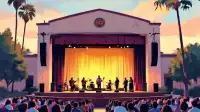

UC Irvine's Winifred Smith Hall hosted a free cross-border concert titled Cauces Sónicos on Oct. 24, as New University reported, bringing together musicians from Southern California and Baja California to showcase original collaborative compositions. The performance represented part of an ongoing two-year project involving undergraduate coursework, traveling performances, and musical compositions designed to explore interaction across the United States-Mexico border.
The initiative was co-led by Michael Dessen, the Robert and Marjorie Rawlins Chair of Music at UC Irvine, and Wilfrido Terrazas, an associate professor of music at UC San Diego. The project received financial support through a $150,000 UC Alianza MX Award in 2025. The overall ensemble gathered faculty members, graduate students, and professional artists affiliated with UC Irvine, UC San Diego, the Universidad Autónoma de Baja California, and Ensenada, Mexico. Together, the participating composers crafted structures that left intentional room for ensemble members to shape the music collectively during performance.
Among the featured composer-performers was Fabricio Cavero, who earned his doctorate from UC Irvine’s Integrated Composition, Improvisation and Technology program in June. Cavero contributed a piece titled Wiskiti, which was built around a rhythmic pattern rooted in traditional music found throughout the Americas. Originally from Cusco, Peru, Cavero connected this central pattern to the broad presence of cumbia across diverse Latin American nations and local communities.
The structure of Wiskiti demonstrated the project's emphasis on gradual improvisation and shared space. The piece began with nine musicians improvising independently around the central rhythm. During the first minute of the performance, each musician operated within a distinct musical space, allowing several individual interpretations to exist simultaneously. In the second minute, the performers reconfigured into three pairs and a trio, subsequently shifting into a quartet and a quintet. By the fourth minute, the entire ensemble merged into a unified cumbia groove, at which point Cavero invited the audience to dance and sing along.
Cavero used rhythm as an accessible entry point to connect listeners with experimental music, offering familiar patterns in place of conventional lyrics. Rather than working strictly toward rigid sequences of written notes, the ensemble relied on open structures that permitted musicians to respond dynamically to one another on stage. Cavero noted that this spontaneous approach made rehearsals easier to coordinate while ensuring that every rehearsal and public performance remained unique.
The broader educational framework of Cauces Sónicos linked all three participating university campuses through an undergraduate course alongside community workshops along the border region. Preparation for the concert combined online communication with physical gatherings. Performers initially shared digital recordings and written scores online before coordinating in-person rehearsals alongside workshops and festival appearances located in Ensenada.
For Terrazas, the project reflects a personal history of cross-border musical engagement. Growing up in Ensenada, Terrazas routinely traveled across the border to San Diego as a teenager to attend flute lessons, join youth orchestras, and pursue other musical training. After joining the faculty at UC San Diego as a professor in 2017, he continued to construct regional artistic projects centered on bringing communities together and facilitating dialogue across different cultural perspectives.
The flexible nature of the project allowed compositions to serve multiple purposes beyond the formal concert stage. Pieces written for auditorium performances were adapted into instructional tools for students or interactive exercises for local residents. Through a collaboration with the UC San Diego Center on Global Justice, Terrazas created a piece for the community of San Ysidro by composing a melody and inviting neighborhood residents to write accompanying lyrics reflecting their local experiences. The finished song was then performed directly with community members.
Looking ahead, the organizers of Cauces Sónicos have planned a musical procession at a migrant shelter in Tijuana. During the upcoming event, participants dressed in blue clothing will move through the shelter following a path inspired by natural water flowing down from mountain slopes. The imagery ties directly into the project's title, which translates to Sonic Channels and draws metaphorically upon the movement of water across a landscape separated by an international border. The Oct. 24 concert at UC Irvine offered local audiences a view into this multi-campus collaboration, highlighting how cross-border artistic partnerships create new venues for shared learning and creative exchange.