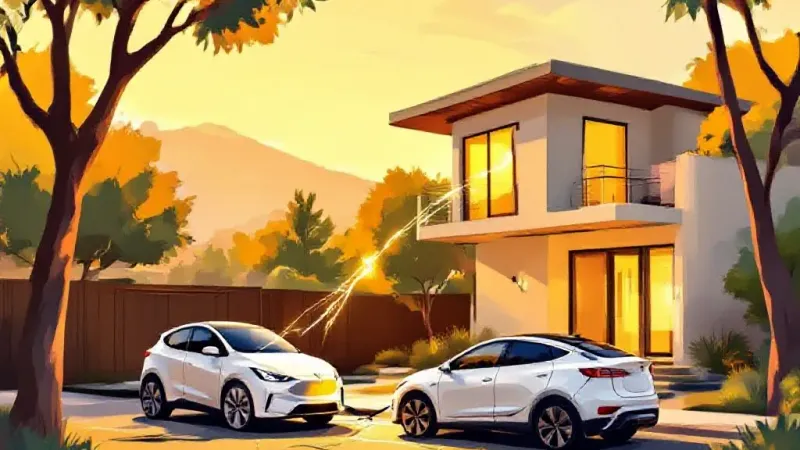
UC Irvine researchers are developing vehicle-to-home (V2H) charging, a system designed to allow electric vehicles to power residential properties. This technology aims to provide homes with electricity during grid outages and offer a method for residents to reduce energy costs by drawing power from their car batteries during peak utility rate periods.
The Advanced Power and Energy Program (APEP) at UC Irvine is leading the V2H research. Scott Samuelsen, a professor of mechanical and aerospace engineering and APEP's founding director, is spearheading the initiative. Collaborating partners include Kia Corp., Hyundai America Technical Center Inc., and Wallbox, a company based in Barcelona, Spain, developing the necessary equipment. Southern California Edison is also involved in the process for grid interconnection.
V2H systems connect a plug-in electric vehicle to a home via bidirectional electric vehicle supply equipment (EVSE). This equipment allows energy to flow both from external sources (solar panels, utility grid) to charge the car, and from the car's battery to power the home when needed. Users manage the system through a smartphone or computer application, setting schedules for power delivery.
Professor Samuelsen highlighted that vehicle batteries are significantly more energy-dense than typical home batteries, offering substantial capacity for home power needs. A fully charged 100-kilowatt-hour EV battery can power a home for days, in contrast to a conventional 13-kilowatt-hour home battery, which typically provides two to five hours of usage. This extended capacity enables homeowners to lessen their reliance on utility power during high-rate hours, usually between 4 p.m. and 9 p.m., potentially saving residents up to $600 per year in utility costs.
Beyond individual savings, Professor Samuelsen noted that widespread V2H adoption could benefit the broader electric grid. The technology offers a reliable power source, particularly relevant in California when utilities may shut down transmission lines to prevent wildfires. Utilities support such innovations due to their interest in improving the electric grid and their need to maintain certifications and grants from agencies like the California Public Utilities Commission. Reduced demand during peak evening hours or hot days could also mitigate the need for rolling blackouts, according to Samuelsen.
The ongoing research includes a residential pilot project in the Shadow Mountain subdivision of Menifee, California. KB Home developed this community as a test bed for sustainable energy and microgrid technologies. Roberta Howell, a 70-year-old resident, is one of half a dozen homeowners participating in the program. Through a lottery managed by UC Irvine, she received a new Kia EV9 sport utility vehicle as a free-of-charge lease, covering only registration and insurance.
In exchange for the vehicle, Ms. Howell shares data from her home's V2H system with researchers at UC Irvine's APEP. Professor Samuelsen emphasized that this data acquisition is critical for understanding the role of electric vehicles in future homes. Initial data from Ms. Howell’s home showed she was not utilizing V2H as intended in the first weeks of the project. This observation highlighted the importance of user-friendly interface design and consumer education for successful adoption, as noted by Samuelsen. Once accustomed to the system, Ms. Howell scheduled V2H to deliver power from 7 to 10 p.m. each evening.
The V2H study began in 2020 when UC Irvine engineers contacted Kia and other partners to explore the technology. Kia, having a history of collaboration with UC Irvine on projects like the Soul EV, agreed to participate. By 2021, Kia decided to advance with V2H, a decision influenced by UC Irvine's role in coordinating partners and its work on enabling V2H in the EV6 model through third-party software updates. This work led to the V2H-ready EV9 for the 2024 model year.
In the fall of 2023, UC Irvine expanded its testing, utilizing advanced EVSE prototypes and an EV9 prototype at both the APEP Residential Laboratory on campus and a KB Home model home in Menifee. Early in 2024, UC Irvine initiated efforts with Southern California Edison to draft a V2H interconnect agreement, a necessary step for connecting any electricity generator to the utility grid. In June 2024, the UC Irvine team and Kia delivered EV9s to the six participating Menifee homeowners, installing Wallbox Level 2 Pulsar Plus chargers.
The commercialization of V2H technology moved forward in 2025 when Wallbox received certification from Underwriters Laboratory for its bidirectional Quasar 2 EVSE. The six Menifee homes were equipped with these first commercial units, necessitating an upgrade of their 50-amp charger circuits to 70 amps. After nearly two years, Southern California Edison approved the V2H interconnect agreement for the first homeowner. This "permission to operate" was signed in May of this year, allowing the first homeowner to commence V2H services at the end of that month. The Menifee project has also revealed "some glaring deficiencies in the timeliness of the interconnection process," according to Samuelsen, as well as regulatory bodies' awareness of the technology.