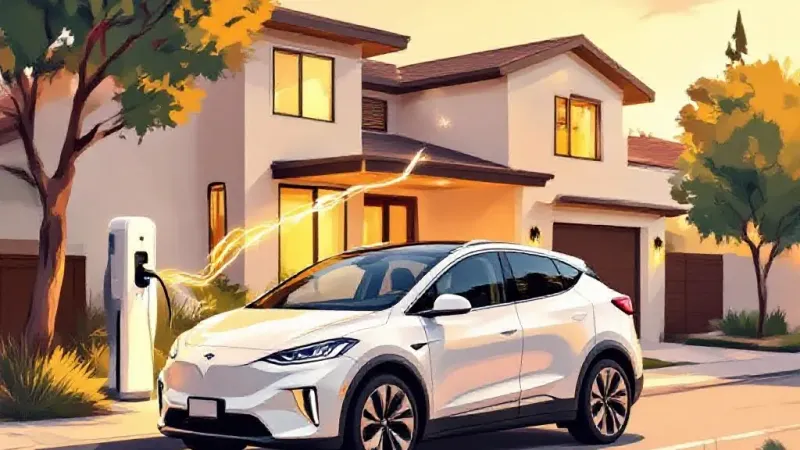
UC Irvine researchers are advancing technology that allows electric vehicles to power homes directly from their batteries. This system, known as vehicle-to-home (V2H) charging, offers a way for residents to maintain electricity during outages and reduce utility costs by drawing power from their car when grid prices are highest.
The Advanced Power and Energy Program (APEP) at UC Irvine is leading the V2H research. Scott Samuelsen, founding director of APEP and professor of mechanical and aerospace engineering, is overseeing the project. Samuelsen emphasizes that data acquisition is a critical component of the research, which aims to understand the future role of electric vehicles in homes and determine if V2H provides “added value to people going forward.”
V2H technology works by allowing energy to flow from solar panels and the electric utility to charge an EV, and then, upon request, from the car to power the home. This requires a plug-in electric vehicle and bidirectional electric vehicle supply equipment (EVSE). Electric vehicle batteries offer a significant advantage for home power, being about eight times more energy-dense than typical home batteries. A fully charged 100-kilowatt-hour EV battery can power a home for several days, compared to a typical 13-kilowatt-hour home battery lasting two to five hours. This allows homeowners to reduce their reliance on utility electricity during peak hours, typically between 4 and 9 p.m., potentially saving up to $600 annually in utility costs, according to Samuelsen.
Utilities are participating in the V2H initiatives due to their interest in grid improvements and their need to prepare for future certifications and grants from agencies like the California Public Utilities Commission. Widespread V2H adoption could reduce the need for utilities to generate and transmit as much energy during peak evening hours or hot days, potentially preventing rolling blackouts.
The V2H study began in earnest in 2020. UC Irvine engineers contacted Kia, Hyundai America Technical Center Inc., and Hyundai Motor Corp. to explore interest in their plug-in electric vehicles for the technology. They also collaborated with Barcelona-based Wallbox on developing bidirectional EVSE. Steve Kosowski, Kia’s manager of long-range strategy and planning, confirmed Kia’s affirmative response to Professor Samuelsen’s initial contact, citing prior collaborations with UC Irvine on projects such as the Soul EV.
Kia, working with Hyundai Motor Corp. in Korea, provided an EV6 all-electric crossover equipped with prototype V2H software. Wallbox supplied the EVSE. These components were tested in the APEP Residential Laboratory on the UC Irvine campus under the direction of Samuelsen and APEP researchers Kate Forrest, Jennifer Lee, and Shan Tian. Kia’s decision to proceed with V2H in 2021 was partly influenced by UC Irvine’s role in bringing together Hyundai Motor Group and Wallbox. This ultimately led to Kia’s release of the V2H-ready EV9 for the 2024 model year.
In the fall of 2023, UC Irvine expanded testing, using advanced EVSE prototypes and a prototype EV9 at both the APEP Residential Laboratory and a KB Home model home in Menifee, California. Early in 2024, UC Irvine began working with Southern California Edison (SCE) to draft a V2H interconnect agreement, which is necessary for connecting an electricity supplier to the utility grid.
In June 2024, the UC Irvine team and Kia delivered Kia EV9 sport utility vehicles to six homeowners in a Menifee neighborhood and installed Wallbox Level 2 Pulsar Plus chargers. One such participant is Roberta Howell, a 70-year-old resident of the Shadow Mountain subdivision in Menifee, whose home is part of a community designed by KB Home as a test bed for sustainable energy. Howell received a Kia EV9 as part of a program managed by UC Irvine, Kia Corp., and Hyundai America Technical Center Inc., covering registration and insurance fees. In exchange, she shares data from her V2H system with UC Irvine researchers.
Howell initially faced a “learning curve for me” with the fully electric home and the V2H system. Samuelsen noted that initial data transmissions from Howell’s home showed she was not using V2H as intended, highlighting the need for a user-friendly interface or occasional consumer education. Once she became accustomed to it, Howell scheduled V2H to provide power from 7 to 10 p.m. daily using a smartphone app.
In 2025, Wallbox received Underwriters Laboratory certification for its bidirectional Quasar 2 EVSE. The six Menifee homes were equipped with these first commercial Wallbox EVSE units, which required upgrading their 50-amp charger circuits to 70 amps. After nearly two years, SCE approved a V2H interconnect agreement for the first homeowner, granting “permission to operate” in May of this year. This allowed the first homeowner to commence V2H services at the end of that month. The Menifee V2H project revealed deficiencies in the timeliness of the interconnection process and regulatory bodies’ awareness of the technology. The project continues to provide insights into the practical application and regulatory hurdles of integrating V2H into residential settings.