
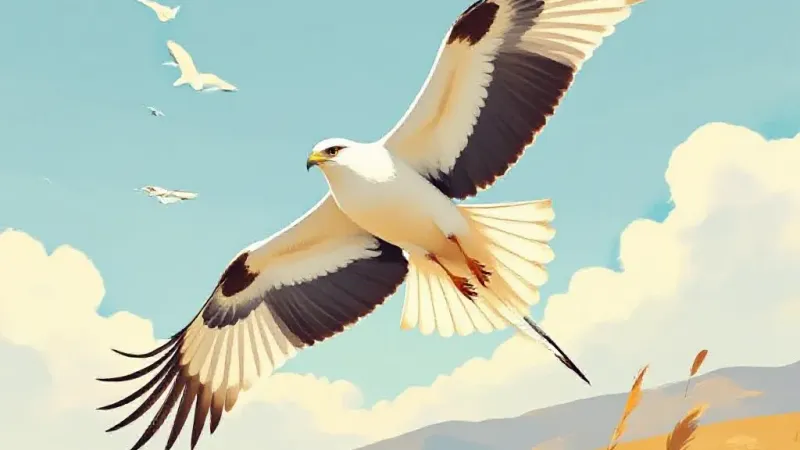
The white-tailed kite, a species of hawk, has seen a significant decline in numbers across Orange County as rolling hills have been developed into housing, business parks, and college campuses. Once numerous, the region now supports only five to seven active white-tailed kite territories, down from an estimated 70 territories where up to 20 were occupied annually.
UC Irvine has emerged as a critical location for the birds, with two nesting pairs consistently raising young on campus. Julie Coffey, a bird scientist and campus reserves manager at UC Irvine, leads a program focused on protecting these raptors, which are a fully protected species in California.
Kites are no longer utilizing the more than 30,000 acres of protected land in Orange County for nesting, breeding, and hunting. Coffey attributes this shift to a combination of climate change, invasive species, and increased wildfires, which are altering landscapes in ways that no longer suit the birds. Consequently, white-tailed kites are adapting to the wildland-urban interface, finding suitable nesting trees with ample leaf coverage around the UC Irvine campus and in University Hills, a residential area for faculty and staff.
Coffey’s program, supported by funding from UC Irvine’s Campus Planning & Sustainability unit and expertise from contracted raptor biologist Pete Bloom, aims to identify the specific needs of white-tailed kites to help them thrive. Researchers have equipped four birds with lightweight electronic backpacks that transmit data every five minutes, tracking movements across the county and beyond; one kite was tracked to Tijuana and back to campus. These transmitters also aid in locating distressed birds, and carcasses found, like one in the San Joaquin Marsh Reserve, are analyzed for causes of death such as West Nile virus or rodenticides. Coffey notes, “We’re witnessing pretty bad mortality for these birds,” underscoring the urgency of their work.
Several threats contribute to the kites’ decline. Great horned owls are significant predators, especially when white-tailed kite roosts are small. Coffey's team learned that a lack of large communal roosts makes individual birds more vulnerable, with two adults and one juvenile lost to suspected owl attacks in the past two years. Crows also pose a danger, particularly to juvenile kites, by ganging up on them.
Human activities in urban areas present further challenges. Rodenticides, used to control pests, can accumulate in the food chain, poisoning kites that feed on affected mice or voles. Coffey encourages organizations to adopt methods like snap traps and birth control for rodent management, following advice from the UC Cooperative Extension, instead of poisons.
Residents of University Hills have been enlisted to help protect the birds. This includes managing outdoor recreation areas and ensuring food waste is properly contained to avoid attracting crows, which can then prey on kite nests. Coffey states that the University Hills community has been cooperative, demonstrating how urban residents can adjust behaviors to support threatened species.
Landscaping practices also play a role. While large, leafy trees planted by humans can be beneficial as favored nesting sites, manicured landscapes can hinder the kites' hunting ability. Coffey plans educational campaigns on campus to promote sustainable landscaping, mindful trash management, and habitat-conscious tree trimming. She emphasizes the importance of white-tailed kites as an “indicator telling us what’s wrong with our own systems or what we could be paying more attention to.”
One successful intervention involved rehabilitating a kite chick found on the ground being attacked by crows. After rehabilitation at the Orange County Bird of Prey Center, the fledgling was returned to its nest along with an orphaned kite. The parents adopted both young birds, with the male parent eventually taking over training after the female left the nest, an event observed through tracking. This incident, Coffey notes, highlights the ongoing learning about the species' social characteristics and habitat use through the tracking program.